

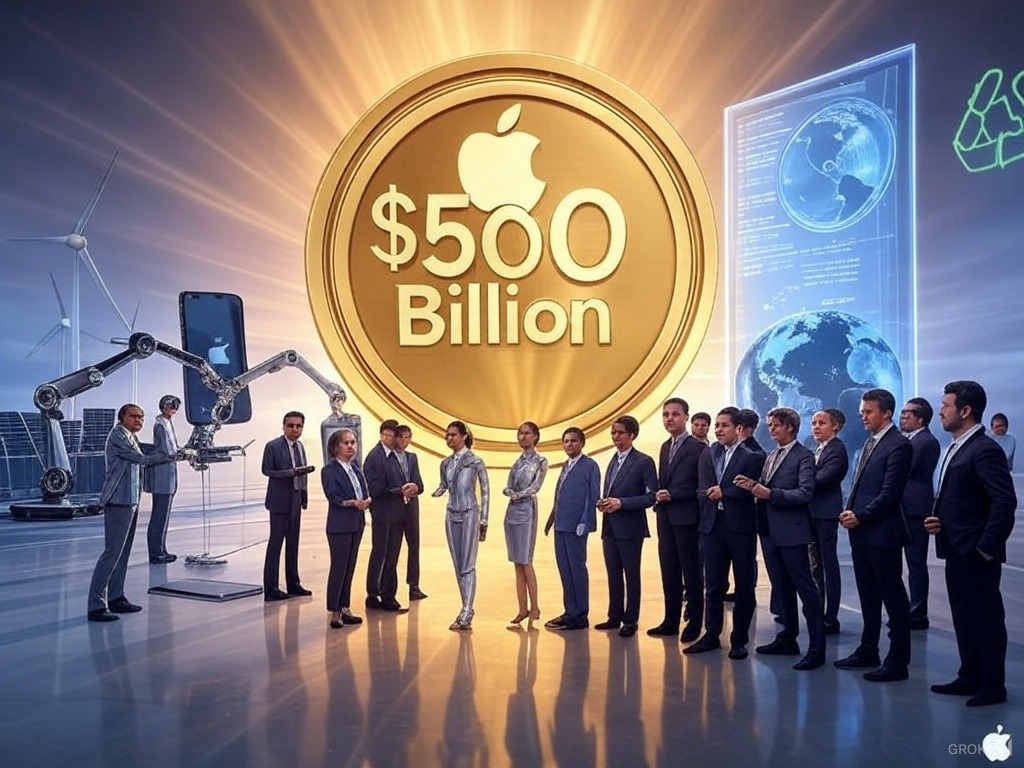
Apple, the tech giant synonymous with innovation, has once again captured global attention with its historic **[500billioninvestmentplan](https://www.apple.com/newsroom/2023/10/apple−announces−major−us−investment−and−job−creation−plan/)∗∗.Thisstaggeringcommitmentisn’tjustafinancialfigure—it’saroadmapforreshapingindustries,acceleratingtechnologicaladvancements,andreinforcingApple’sleadershipintheglobaleconomy.FromboostingU.S.manufacturingtopioneeringsustainabilityinitiatives,Apple’sinvestmentunderscoresitsvisiontoredefinewhat’spossible.Inthisblogpost,we’lldissecthowthis500billioninvestmentplan](https://www.apple.com/newsroom/2023/10/apple−announces−major−us−investment−and−job−creation−plan/)∗∗.Thisstaggeringcommitmentisn’tjustafinancialfigure—it’saroadmapforreshapingindustries,acceleratingtechnologicaladvancements,andreinforcingApple’sleadershipintheglobaleconomy.FromboostingU.S.manufacturingtopioneeringsustainabilityinitiatives,Apple’sinvestmentunderscoresitsvisiontoredefinewhat’spossible.Inthisblogpost,we’lldissecthowthis500 billion investment will transform Apple’s operations, benefit consumers, and send ripples across the tech industry. Let’s dive in.

**Breakdown of the 500BillionInvestment∗∗Apple’s500BillionInvestment∗∗Apple’s500 billion investment is a multi-faceted strategy designed to fuel growth across key areas. Here’s how the company plans to allocate its resources:
Manufacturing Expansion ($150 billion): A significant chunk will go toward building new factories, upgrading existing facilities, and securing partnerships with suppliers. Apple aims to reduce reliance on overseas production by expanding its U.S. manufacturing footprint, particularly in states like Texas and Arizona. According to a Reuters report, this move could reshore critical supply chains for semiconductors and displays.
Research & Development ($120 billion): Innovation is Apple’s lifeblood. This investment will fund breakthroughs in AI, augmented reality (AR), and silicon design (like the M-series chips). Expect advancements in health tech, autonomous systems, and next-gen devices.
Sustainability Initiatives ($80 billion): Apple is doubling down on its 2030 carbon-neutral pledge, with funds supporting renewable energy projects, recycling programs, and eco-friendly material research.
Infrastructure & Data Centers ($70 billion): To support its growing services (like iCloud and Apple TV+), the company will build energy-efficient data centers and improve its global network infrastructure.
Workforce Development ($50 billion): Apple plans to upskill employees, expand its STEM education programs, and create 20,000 new jobs in the U.S. over the next decade.
AI & Machine Learning ($30 billion): From enhancing Siri to developing predictive healthcare tools, AI remains a priority.
This strategic allocation ensures Apple stays ahead in tech while addressing societal challenges like climate change and workforce inequality.

Apple’s Impact on the U.S.Economy
Apple’s investment isn’t just a win for the company—it’s a catalyst for economic growth. Here’s how:
Job Creation: The expansion of manufacturing and R&D centers will create thousands of high-paying jobs. Apple estimates its investments will support over 2 million U.S. jobs, including roles in construction, engineering, and retail. The Bureau of Labor Statistics highlights that tech manufacturing roles pay 50% more than the national average.
Supply Chain Boost: Domestic suppliers will benefit from Apple’s “Made in America” push. Companies like Corning (makers of iPhone glass) and 3M will see increased demand.
Tax Contributions: Apple’s U.S. operations contributed $15 billion in federal taxes in 2022. With new facilities, this figure could rise significantly.
GDP Growth: Analysts at McKinsey & Company predict Apple’s activities could add $50 billion annually to the U.S. GDP by 2030.
By anchoring its growth stateside, Apple is positioning itself as a cornerstone of America’s economic future.

Expansion of Manufacturing and Innovation
Apple’s manufacturing expansion is a game-changer. The company is building its first U.S.-based microLED display facility in Texas, reducing dependency on Asian suppliers. Additionally, its partnership with GlobalFoundries in New York will ramp up chip production for iPhones and Macs.
Innovation-wise, Apple is pushing boundaries:
AR/VR: A rumored $3,000 AR headset could revolutionize industries from healthcare to education. Bloomberg reports the device may debut in 2024.
Health Tech: The Apple Watch’s blood glucose monitoring and FDA-approved ECG features hint at a future where wearables replace medical devices.
Silicon Dominance: The M2 Ultra chip, with 134 billion transistors, showcases Apple’s engineering prowess.
These efforts ensure Apple remains at the forefront of tech innovation.

Infrastructure, Sustainability & AI Projects
Apple’s infrastructure investments focus on two pillars: sustainability and scalability.
Renewable Energy: The company is constructing solar farms in Nevada and wind facilities in Illinois to power its operations with 100% clean energy. The Environmental Protection Agency (EPA) lauded Apple’s commitment to grid decarbonization.
Recycling Breakthroughs: Apple’s Daisy robot disassembles 200 iPhones/hour, recovering materials like cobalt for reuse.
AI Advancements: Machine learning is enhancing features like Photos’ object recognition and iOS’s predictive text.
These projects align with Apple’s mission to “leave the world better than we found it” while driving efficiency.
How This Investment Benefits Consumers
For everyday users, Apple’s $500 billion plan translates to:
Better Products: Faster chips, longer battery life, and immersive AR experiences.
Eco-Friendly Choices: Carbon-neutral devices and recycled packaging. The Verge highlights Apple’s shift to 100% recycled cobalt in batteries by 2025.
Enhanced Services: Improved iCloud storage, smarter Siri, and exclusive Apple TV+ content.
Lower Costs: Economies of scale could reduce prices for accessories like AirPods.
Ultimately, consumers gain access to cutting-edge tech that’s both powerful and sustainable.
Competitor Reactions and Industry Impact
Apple’s move has sent shockwaves through the tech sector.
Samsung and Google are accelerating their own AI and chip projects to keep pace. The Wall Street Journal notes Samsung’s $200 billion semiconductor investment to counter Apple.
Microsoft is investing heavily in AR to counter Apple’s headset.
Tesla and Apple may clash in the autonomous vehicle arena.
Smaller companies face a dilemma: compete or collaborate. Many, like Dropbox, are integrating deeper with Apple’s ecosystem to survive.
The investment also pressures industries to adopt greener practices, mirroring Apple’s sustainability focus.
Challenges and Risks
Despite its scale, Apple’s plan isn’t foolproof:
Supply Chain Vulnerabilities: Geopolitical tensions or shortages could delay production. The U.S.-China Trade War remains a lingering threat.
Regulatory Scrutiny: Antitrust lawsuits, like the DOJ’s 2023 case, may target Apple’s growing dominance.
Market Saturation: With 1.46 billion active iPhones, growth in key markets is slowing.
Tech Hurdles: AI and AR are still nascent; consumer adoption isn’t guaranteed.
Apple must navigate these risks to realize its $500 billion vision
Conclusion
Apple’s $500 billion investment is more than a financial headline—it’s a testament to the company’s ambition to lead the next era of tech innovation. By strengthening U.S. manufacturing, prioritizing sustainability, and pushing AI boundaries, Apple is crafting a future where technology serves humanity responsibly. While challenges loom, the potential rewards for the economy, consumers, and the planet are immense. As Apple CEO Tim Cook once said, “We’re betting on our future, and we’re betting big.” One thing’s certain: the world will be watching.