Nvidia stands at the center of this season’s most anticipated earnings announcements. With strong demand for its new Blackwell chips and global tech giants eager to buy more, investors and analysts are watching every move. But beyond the buzz, what should investors really expect from Nvidia’s Q1 earnings? And what role do other tech giants like Salesforce and Apple play in shaping the outlook for the industry?
Let’s break down what matters most for Nvidia’s earnings, the big questions on China and the Middle East, and how broader technology strategies—like Salesforce’s $8 billion Informatica deal and Apple’s manufacturing pivot—could shift the tech landscape.
Nvidia’s Upcoming Q1 Earnings Report: What Matters for Investors
Nvidia’s first quarter earnings report will arrive after the market closes, and for many investors, it’s more than just another update. The company’s results have become a core data point for assessing the health of the entire chip sector.
Why is this report so important?
Nvidia has delivered a double beat—beating both top and bottom-line analyst estimates—for the past seven quarters.
Strong demand for AI chips, especially the new Blackwell series, continues to drive optimism.
Analysts are laser-focused on signs of ongoing growth, despite some background “noise” in the market.
Navigating the Analyst Noise
Ahead of the earnings call, analysts highlighted several concerns:
H20 ban: Restrictions on Nvidia’s high-end chips for the Chinese market.
Macroeconomic uncertainty: Broader global economic worries.
But according to Patrick Moorhead, founder and CEO of Moor Insights & Strategy, only two issues truly matter now:
China market risk: Ongoing export restrictions threaten Nvidia’s share in the region, but the company could develop a B20 or specially tuned Blackwell chip for compliance.
Middle East demand: Nvidia has new business in the Middle East, especially in Saudi Arabia and the UAE, which could offset some China losses.
Capital expenditure (capex) forecasts from the major cloud companies remain steady, and these guide expectations for future Nvidia sales. There will likely be some “gross margin pressures” as Nvidia speeds up materials sourcing and assembly for Blackwell production. However, analysts do not expect margins to erode as much as in previous quarters.
The China and Middle East Equation: Offsetting Risks
Nvidia faces a tough balancing act. On one side are tight export rules in China, on the other, fast-growing opportunities elsewhere.
China Market: Revenue at Risk
Nvidia’s H20 chips, intended for export to China, could face further bans or require major write-offs.
Some H20 parts might still be repurposed for inference chips in the United States, softening the blow.
If Nvidia’s China business collapsed completely, Middle East deals could partially fill the gap.
Middle East: The New Growth Driver?
Nvidia has not shared many details on these Middle East deals, but they are already making a difference. According to expert estimates, new business in the region could:
Offset up to 30% of lost revenue if the China market goes to zero
This is not a complete replacement, but it’s a significant buffer. As Nvidia diversifies into new global markets, its risk profile shifts, and investors gain some insurance against geopolitical shocks.
What’s Next: A Stronger Second Half for Nvidia?
Many bullish investors believe Nvidia’s next big leap will come later this year. Why? Because the second half looks packed with catalysts.
Reasons for Second-Half Optimism
Cloud giants are set to keep buying more hardware, pushing data center demand.
The Blackwell chip launch will bring much faster performance—more tokens processed per dollar and per second—a big selling point for AI and hyperscale users.
Nvidia’s recent decision to let Blackwell 200 and Blackwell 300 share components means customers can upgrade more easily, smoothing adoption.
Blackwell Chip Advantages
Higher performance at lower cost.
Easy migration for customers upgrading from previous models.
Designed for rapid, large-scale deployment.
Capex commitments from the world’s largest tech firms remain steady, signaling that Nvidia is likely to see strong demand throughout the rest of the year. Risks appear to be lower for the coming quarters, strengthening investor confidence.
Salesforce’s Informatica Acquisition: Strategy, Skepticism, and AI Ambitions
While chip companies grab headlines, Salesforce made a major move, announcing an $8 billion acquisition of Informatica. The goal: strengthen its edge in data management and AI enablement. But Wall Street is divided.
The Deal and Analyst Doubts
RBC analyst Rishi Jaluria shared a skeptical view:
“While on paper the deal can make sense integrating MuleSoft, Tableau and Data Cloud, we question this vision given the lack of integration of Salesforce assets. Furthermore, we wonder if there’s any major advantage to buying Informatica versus partnering.”
Why the Acquisition Could Work
Data integration challenges have climbed to the top of every CIO’s list. Generative AI demands fast, coherent access to data scattered across different systems. Salesforce wants to close this gap by bringing Informatica’s tools onboard. In this new AI world, data flows “east-west”—between many platforms and services—rather than just “north-south” in traditional machine learning setups.
Traditional Machine Learning
Data is often piped from source directly to model (north-south).
Focus on specific datasets, like CRM data.
Generative AI
Need to connect CRM, ERP, SEM, and more (east-west).
Complexity grows with each connection.
Salesforce’s Data Cloud has grown quickly for this reason. Fast, simple integration could unlock more AI power for customers. But to win, Salesforce must solve its ongoing integration and complexity headaches.
Reducing integration pain is critical. If Salesforce can streamline operations and merge Informatica’s strengths fast, it stands to gain—if not, complexity could stifle progress.
Salesforce’s Growth: M&A Strategy and the Road Ahead
Will Salesforce ramp up dealmaking after this Informatica purchase? All signs point to yes—especially if organic growth lags.
M&A activity likely to increase if growth slows.
Informatica’s purchase appears motivated by long-term potential, not just today’s revenue.
Industry watchers were surprised that Salesforce did not target Cloudera, which remains private and would have cost more but could have offered a better strategic fit.
Regulatory barriers might slow future major deals, but analysts expect Salesforce to pursue more mergers if needed to boost its platform and revenue streams.
Apple’s Manufacturing Moves: U.S., Mexico, or Beyond?
Apple’s future manufacturing plans generate as much interest as its next iPhone. Facing global supply chain shifts, rising trade tensions, and political pressure, the company finds itself at a crossroads.
The U.S. Manufacturing Puzzle
Building iPhones in the United States has long faced deep skepticism. Over the past three decades:
Experts and executives said it could not be done here.
Tim Cook acknowledged that only China could deliver the required manufacturing scale.
Yet, the playbook is shifting. Apple has already ramped up iPhone production in India, and TSMC—the chipmaking giant—recently built a major fab in Arizona.
Four Key Challenges to U.S. iPhone Manufacturing
Insufficient labor pool: The U.S. does not have enough workers for massive tech manufacturing.
Skills gap: The industry needs more skilled manufacturing technicians and engineers.
Need for automation: U.S. production would demand much more robotic assembly.
Design changes: Apple’s products would require redesigning for large-scale automated manufacturing.
Why Mexico Might Be the Answer
Mexico has become a logical alternative:
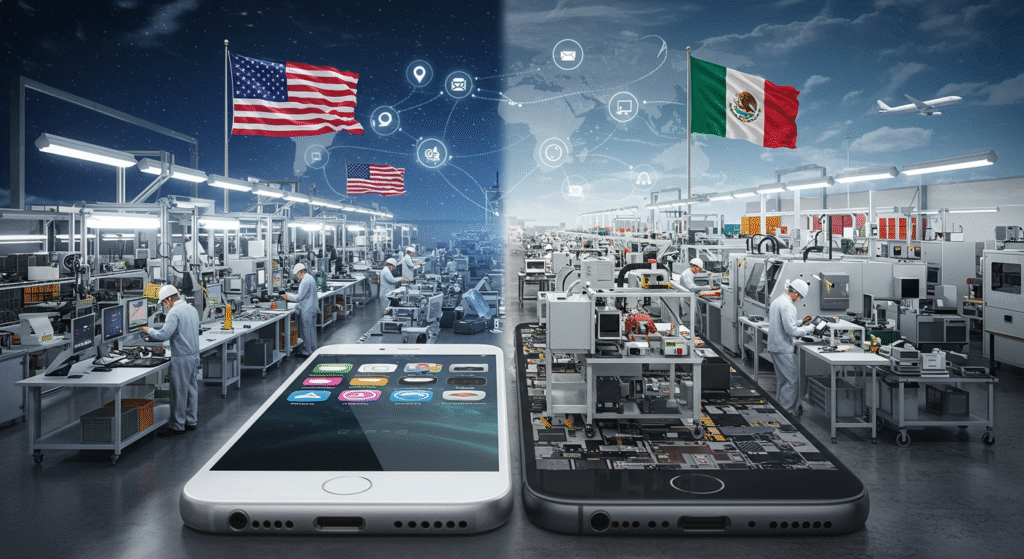
Many Taiwanese and Chinese contract manufacturers (ODMs) operate there, already producing servers and desktops for Apple and other hardware firms.
Adapting these lines for iPhone assembly could remove many cost barriers that exist in the U.S.
The Political Angle
Former President Trump, and others, have called for manufacturing to move home to the U.S.—preferably states like Ohio. Apple’s leadership must balance practical logistics with these political dynamics.
“Apple should immediately commit to a U.S. manufacturing engineering site, aiming to design and build some iPhones in America.”
Showing a commitment, even symbolically, could reset perceptions and protect market goodwill, especially if Apple responds proactively to U.S. policymakers instead of reacting under pressure.
Conclusion
Nvidia’s earnings are a key indicator for the broader technology sector. Despite risks in China, new opportunities in the Middle East and robust product launches keep the outlook bright. Salesforce’s aggressive data strategy shows the growing importance of integrating AI with real-world business data, though execution risks remain. Meanwhile, Apple’s evolving supply chain strategy reflects the pressures and possibilities of manufacturing in a post-globalization world.
Staying informed on these trends is more important than ever. Tech investors must keep an eye on earnings results, geopolitical shifts, and the moves of industry giants as the landscape continues to shift.